INTRODUCTION.
My research journey started in my second year of university after taking a course called Introduction to Microbiology. Before taking this course I knew a little bit about research and what it was but didn’t know what or how to get involved. After this course I found a new area of science that I was passionate about and I wanted to dive deeper and learn more. I was fortunate enough to be accepted by my supervisor Naowarat (Ann) Cheeptham who helped me advance my skills in microbiology. Eventually my research projects took a turn and I realized how interdisciplinary research can be. I am currently combining fields of microbiology, physics, chemistry and political science in my most research projects that involve looking at microplastics in municipal composting and identifying bacteria that are able to break down the plastics.
The research projects I have taken part in are all community driven research that puts the values and concerns of the community at the forefront for the goals we create. This all started when a curious community member wanted to know more about the bacteria in her own personal compost. For this project I completed an Apprenticeship and Directed Studies at TRU. This project then evolved into my next three projects in partnership with the City of Kamloops. I completed a UREAP, Mitacs Accelerated Internships and Honours thesis that continued to build off of the question, “what is in our compost?”.
I have been lucky enough that my research has been able to take me around Canada. I have presented at four national conferences and four TRU conferences so far. Of these national conferences I have gotten to go to London ON, Montreal QC, Bamfield BC, and Vancouver BC. Being able to travel, learn from others and be given the opportunity to talk about my research has been one of my favourite parts about my research journey so far.
Evidence.
Possible examples of evidence:
Research Proposals:
Directed Studies
A program provided though TRU that requires students to review the literature in their area of study, offer critical assessment of that literature, and submit a comprehensive review paper. For this course I completed research on the microbial diversity of vermicompost while using cardboard as a bedding type.
UREAP
The Undergraduate Research Experience Award Program (UREAP), is offered through TRU as a way to complete your own original research under a faculty supervisor. In this project students must complete literature review and proposal plan for the project before being accepted by the awards committee. For this project I was determining the effects cardboard has on the microbial diversity in Kamloops municipal compost.
Mitacs Accelerate Internship
The Mitacs Accelerate Internship is a research base internship that brings together university with industry and community partners. This internship requires a literature review that is heavily weighted in acceptance of the internship application. Through this partnership I was able to collaborate with Thompson Rivers University and the City of Kamloops on the detection of microplastics in Kamloops municipal compost which gave me both laboratory and policy action experience.
Honours
The honours program at TRU is a research project completed in addition to your degree upon graduation. For this program a proposal thesis is required for the acceptance into the program and to provide background information about what you will be studying over the next year. My honour projects focuses both on a method development for the detection of microplastics in compost as well and identifying native bacteria from the compost that have the potential to break down and metabolize microplastics
Grant Proposals:
Climate Action Grant 2024 and 2025
The Climate Action Grant is a grant funded my the City of Kamloops that focusses on community-based climate action projects that will help advance the the goals of Kamloop’s Community Climate Action Plan. For these two grant application, a literature review is required to explain the goals of the project and the plan going forward as well as how the project is related Kamloop’s climate actions goals.
Climate Action Grant 2025
(submitted on an online platform)Download
Student Sustainability Research Grant 2024
TRU provides opportunities for both faculty and students to apply for research grants for projects related to sustainability. The Student Sustainability Research Grant requires a literature review to support the goals of the project. The acceptance of this grant is based on the extend of the proposal.
Research Courses:
BIOL 3980- Introduction to Research
This course is available to 3rd year students contemplating entry into the Honours program or undertaking a Directed Studies research project in their last year. The seminar focuses on formulation of a research hypothesis and production of a research proposal in preparation for application to do an Honours or Directed Study research project. Honours students are expected to take this course, although the learning objectives may be completed under the supervision of an individual faculty member.
BIOL 4490- International Field School
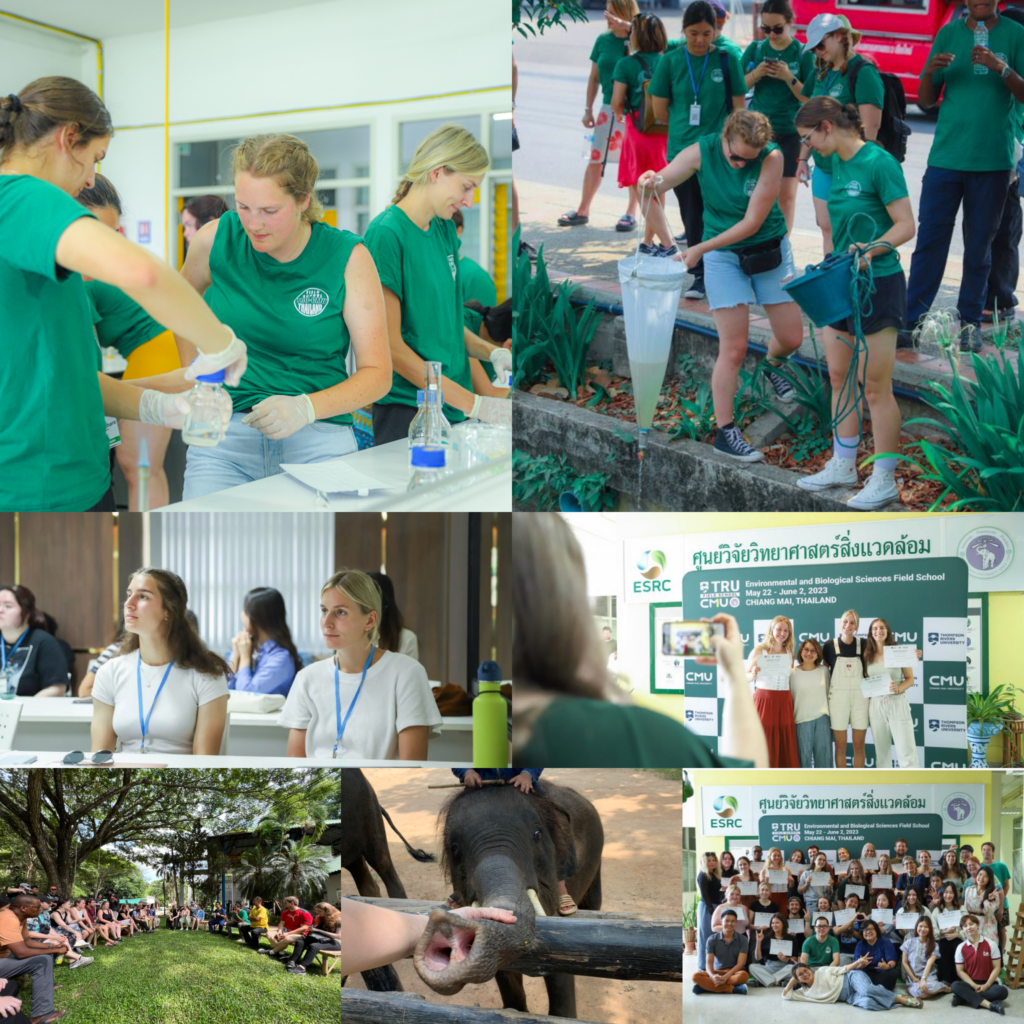
In this advanced seminar course, students focus on recent developments in modern biology. Topics are selected from the instructor’s area of expertise and vary from year to year. For the course I took in 2023 it was focused on how climate change impacts the microbial world through a One Health perspective. Part of this course was completed in Kamloops at TRU while the other was in Chiang Mai, Thailand at the University of Chiang Mai. Through this course I was exposed to unique research experiences that allowed me to explore research in a different culture.
Possible examples of evidence:
Literature Reviews:
Directed Studies
A program provided though TRU that requires students to review the literature in their area of study, offer critical assessment of that literature, and submit a comprehensive review paper. For this course I completed research on the microbial diversity of vermicompost while using cardboard as a bedding type.
UREAP
The Undergraduate Research Experience Award Program (UREAP), is offered though TRU as a way to complete your own original research under a faculty supervisor. In this project students must complete literature review and proposal plan for the project before being accepted by the awards committee. For this project I was determining the effects cardboard has on the microbial diversity in Kamloops municipal compost.
Mitacs Accelerate Internship
The Mitacs Accelerate Internship is a research base internship that brings together university with industry and community partners. This internship requires a literature review that is heavily weighted in acceptance of the internship application. Through this partnership I was able to collaborate with Thompson Rivers University and the City of Kamloops on the detection of microplastics in Kamloops municipal compost which gave me both laboratory and policy action experience.
Honours
The honours program at TRU is a research project completed in addition to your degree upon graduation. For this program a proposal thesis is required for the acceptance into the program and provide background information about you will be studying over the next year. My honour projects focuses both on a method development for the detection of microplastics in compost as well and identifying native bacteria from the compost that have the potential to break down and metabolize microplastics
BIOL- 4350 Gene Regulation: Report
In this course we were required to do a group literature review project on how trauma can impacts a person’s epigenetics. For this group project I contributed mostly to the correlation studies on “Heritability of PTSD from Holocaust Survivors” and “Intergenerational Trauma in Indigenous Populations Resulting in Obesity” as well as the conclusions.
Course Presentations:
BIOL-4350 Gene Regulation: Presentation
In this course we were required to do a group presentation on how trauma can impacts a person’s epigenetics. I contributed to the majority of the work for the correlation studies found from the literature that relates to our question on how trauma can affect future generation through epigenetics.
Published Literature Review:
I was fortunate enough to be given the opportunity to be apart of a liturature review the reflects my experience studying microplastics. For this literature review titled “Nanoscale plastic pollution: sources, identification and potential mitigation” I did extensive research on literature about micro- and nanoplastics. In the final copy of the published review I wrote parts of the introduction and most of sections 2.21, 2.2.2, 3.3.1, and 3.3.2. In addition, I also created figures 1, 4, and 9
DOI:
Possible examples of evidence:
CBC Radio Interview:
The Daybreak Kamloops CBC radio program invited myself and other lab members an opportunity to talk about the research we were doing in the Dr. Cheeptham’s lab. During this interview, I was able to describe my research on the detection and potential degradation of microplastics in compost.
Final Reports:
Directed Studies
Final Report
A final report was provided to my supervisors which outlined what was completed through the project. In this project the results show that I was able to successfully describe the microbial diversity in vermicompost using culture based microbiology techniques.
City of Kamloops Final Report
A report for my research during my Directed Studies was also completed for the City of Kamloops. In this report the explanation of the findings were adjusted to make it more digestible for other audiences that do not have an in depth knowledge in microbiology but are still able to follow my methodologies and see noticeable progress in the project. This report was used as a final submission for the Climate Action Grant funded by the City of Kamloops.
UREAP
Final Report
For the Undergraduate Research Experience Award Program (UREAP), a final report was completed and provided to my supervisors. This report outlines what was accomplished in the project and shows evidence of methodologies used to determine the microbial diversity in test trials of compost containing different types of cardboard.
City of Kamloops Report
A report for my research during my Undergraduate Research Experience Award Program (UREAP) was also completed for the City of Kamloops. The goals of the city was to learn if the addition of cardboard in compost had any negative impacts on the microbial diversity and their ability to assist in the composting process. For this report the explanation of the finding was adjusted to make it more digestible for other audiences that do not have an in depth knowledge in microbiology. This report was also used as a final submission for the Climate Action Grant funded by the City of Kamloops.
Mitacs Accelerate (Interim Report)
An interim report of what had been completed half way though the Mitacs Accelerate Internship was completed and shared with my faculty supervisors and community partners for the project. This report summarizes what has been completed in the method development for detecting microplastics in compost. In addition, this report also provides an update on future work for the remainder of the project.
Possible examples of evidence:
Research Reports:
Directed Studies
A final report provided to my supervisors was created that outlined what was accomplished in the project. This report was graded for my completion of the Directed Studies course at TRU.
UREAP
For the Undergraduate Research Experience Award Program (UREAP), a final report was completed and provided to my supervisors. This report outlines what was accomplished in the project and was a way to confirm my completing of the project to hand out the second half of stipend from this award.
Mitacs Update Report
An interim report of what had been completed half way though the Mitacs Accelerate Internship was completed and shared with my faculty supervisors and community partners for the project. This report summarizes what has been completed and an update on future work for the remaining of the project.
Poster Presentations:
TRU Undergraduate Research Conference- 2024, 2025
This is an undergraduate conference at TRU that is open to any faculty. In 2024 I presented a poster on the microbial diversity in vermicompost with the use of cardboard as a bedding type and in 2025 my poster was on microbial diversity of municipal compost and the impact different types of cardboard has on microbial diversity.
SUPER- 2024, 2025
The Science Undergraduate Poster Exhibition of Research is a conference at TRU for the faculty of science. For the conference in 2024 I presented a poster for my research on the microbial diversity in vermicompost with the use of cardboard as a bedding type and in 2025 my poster was on microbial diversity of municipal compost and the impact different types of cardboard has on microbial diversity.
Canadian Society of Microbiology (CSM)- 2024, 2025
CSM is an annual conference for Canadian microbiology. In 2024 the conference was help in London, ON and I presented a poster for my research on microbial diversity in vermicompost with the use of cardboard as a bedding type. In 2025 the conference was held in Montreal, QC. For the poster I presented it was on my reach of studying the microbial diversity of municipal compost and the impact different types of cardboard have.
Canadian Undergraduate Physics Conference (CUPC)- 2024
CUPC is an undergraduate focused conference in physics. This conference was held in Vancouver, BC where I presented a poster on my research for the detection of microplastics in compost using different microscopy and spectroscopy techniques.
Pacific Ecology and Evolution Conference (PEEC)- 2025
PEEC is an ecology conference that is held annually at the Bamfield Marine Sciences Centre (bmsc). At this conference I presented a poster for my reach on microbial diversity in municipal compost with the addition of different types of cardboard. At this conference I received first place for the poster competition.
In a Nutshell 2025
In a Nutshells is TRU’s take on an undergraduate version of the Three Minute Thesis post-graduate competition. This competition was for TRU undergraduate research students and each presenter has no more than three minutes to describe their project. For this competition I presented my research on the microbial diversity of municipal compost with the addition of different types of cardboard. I was awarded third place in this competition.
Possible examples of evidence:
Poster Presentations:
TRU Undergraduate Research Conference- 2024, 2025
This is an undergraduate conference at TRU that is open to any faculty. In 2024 I presented a poster on the microbial diversity in vermicompost with the use of cardboard as a bedding type and in 2025 my poster was on microbial diversity of municipal compost and the impact different types of cardboard have on microbial diversity.
SUPER- 2024, 2025
The Science Undergraduate Poster Exhibition of Research is a conference at TRU for the faculty of science. For the conference in 2024 I presented a poster for my research on the microbial diversity in vermicompost with the use of cardboard as a bedding type and in 2025 my poster was on microbial diversity of municipal compost and the impact different types of cardboard have on microbial diversity.
Canadian Society of Microbiology (CSM)- 2024, 2025
CSM is an annual conference for Canadian microbiology. In 2024 the conference was help in London, ON and I presented a poster for my research on microbial diversity in vermicompost with the use of cardboard as a bedding type. In 2025 the conference was held in Montreal, QC. For the poster I presented it was on my reach of studying the microbial diversity of municipal compost and the impact different types of cardboard have.
Canadian Undergraduate Physics Conference (CUPC)- 2025
CUPC is an undergraduate focused conference in physics. This conference was held in Vancouver, BC where I presented a poster on my research for the detection of microplastics in compost using different microscopy and spectroscopy techniques.
Pacific Ecology and Evolution Conference (PEEC)- 2025
PEEC is an ecology conference that is held annually at the Bamfield Marine Sciences Centre (bmsc). At this conference I presented a poster for my reach on microbial diversity in municipal compost with the addition of different types of cardboard. At this conference I received first place for the poster competition.
In a Nutshell
In a Nutshells is TRU’s take on an undergraduate version of the Three Minute Thesis post-graduate competition. This competition was for TRU undergraduate research students and each presenter has no more than three minutes to describe their project. For this competition I presented my research on the microbial diversity of municipal compost with the addition of different types of cardboard. I was awarded third place in this competition.
Honour Update Presentations:
The Heart of My Project
This presentation is a short 6 minute presentation that was done for the Honours course as a way to practice presenting information about my Honours research. The purpose of this presentation was to give an overview of what the project is and the methods that would be followed.
Why My Project is Important
This was another Honours course presentation where I had 6 minutes to describe my reach project. The goal of this presentation was the explain the importance of my research to an audience that does not know what my project is about by making it relatable and engaging.
Honours Update Presentation
The Honours Update Presentation is a required portion of the the Honours Thesis program. In this presentation we have to present and 8 minute presentation with time for 2 minutes of question. For this presentation we are updating fellow science professors and students about what has been completed so far in the project. This presentation outlines the importance of the project, the methodology and perliminary results of the project.
Community Outreach:
Kamloops Farmers Market (Soapbox Science)
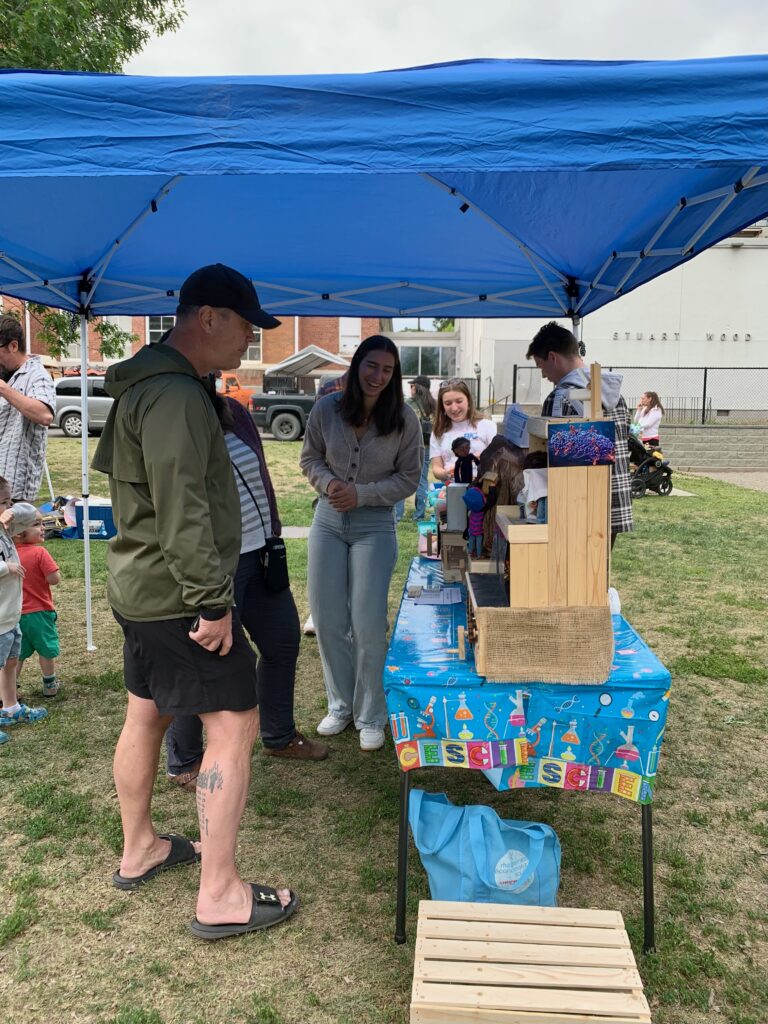
Soapbox Science is a public outreach program that allows scientits to present their reach to the public in a fun and educational way. For this event I partnered with faculty of science at TRU who helped organize the event at the Kamloops Farmers Market. During this event myself and my rsearch team of supervisors and other research students were able to discuss our research on microplastics in compost.
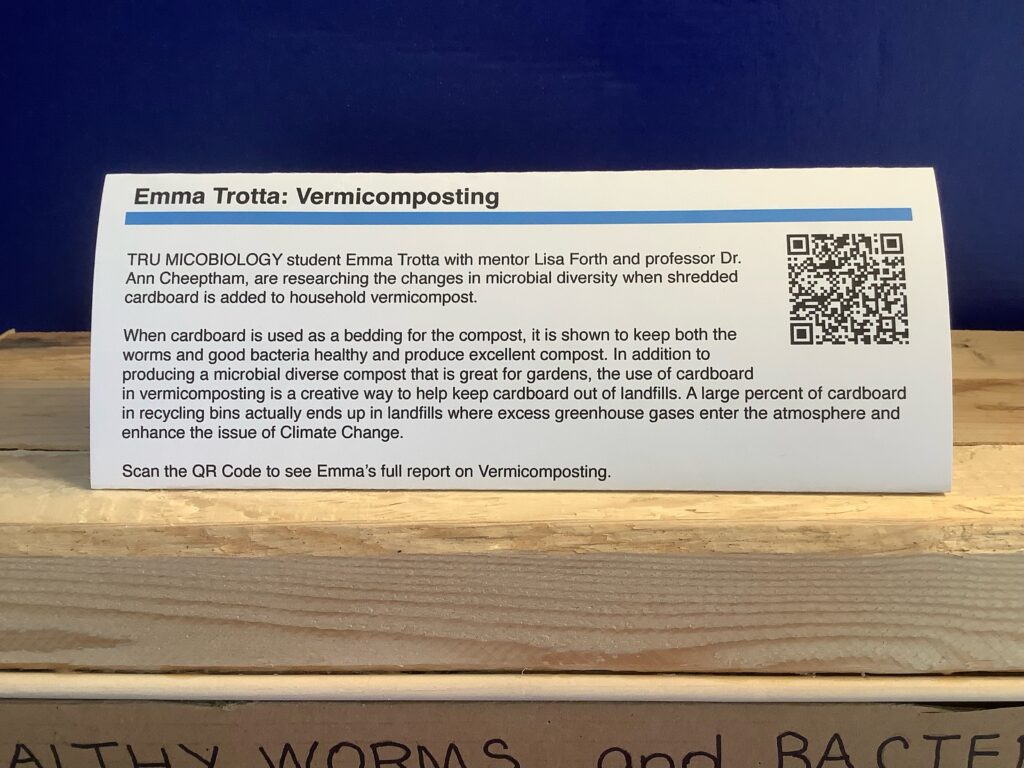
In addition, I have also participated in another Soapbox Science event at the Kamloops Farmers Market were I was able to share my knowledge of microbiology that I learned through course and research. At this event we partnered with a local artist who made an automata (automatic kinetic sculpture) of my research project on cardboard in vermicompost.
CBC Radio Interview:
The Daybreak Kamloops CBC radio program invited myself and other lab members an opportunity to talk about the reach we were doing in the Dr. Cheeptham’s lab. During this interview, I had was able to describe my research on the detection and potential degradation of microplastics in compost.
REFLECTIVE ESSAY.
Trying to sum up how research has impacted my life in such a short reflection is difficult to do. The research I have done has shaped my life and my future in ways that I never imagined. I have always thought it would be interesting to do research at university but I wasn’t prepared for how much I would learn throughout the process.
During my years at TRU I have been doing research for about three years. Each year I learned more about the research process but also more about myself and my community. I have been fortunate enough to collaborate with the City of Kamloops on multiple research projects. The experiences I gained working with a community partner has made me realize the impact my research can have on the people around me. During my research on developing new improvements to the Kamloops municipal composting program, the results of my research have had an impact on how the city uses their compost as well as people in the community. From this collaboration I learned the importance of building strong relationships and I have learned that for any future projects I do that I should try and build these relationships with other community members or policy makers in order to implement the results of my research.
Another lesson I have learned from doing research is how interdisciplinary the field is. Even though most of my research has been focused in microbiology, different areas of science like physics and chemistry as well as government and political science have been a part of many of my projects. I have learned that collaboration is key. I cannot become an expert in everything that a research project may require so drawing on others and learning to work together can create research projects that encompass the complexity of the natural world. During group meetings I was fascinated to see how faculty in biology, physics and chemistry were able to bounce ideas off of each other to solve issues we were facing in the project. Being able to experience this in my undergraduate degree was a key moment in understanding the work and collaboration that is required to create a research project.
I have always been curious about various biological systems and this curiosity is what initially led me into research. Research involves a curious mind, strength, resilience, and an ability to learn from your mistakes. From my experience of doing reach at TRU I have become well diversified in these transferable skills. I have had experiments that have failed, set backs in equipment, but I have been able to learn from these mistakes and have come up with creative solutions to persevere throughout the projects. Throughout my education I have been conditioned to do my best and receive the best grades, however with research there are no grading systems. I cannot study and prepare for all issues that may arise in a project. This was a learning curve for me when I first started research, I have always strived for perfection but after doing research I have realized that the ability to adapt and problem solve to different outcomes is what makes a research successful.
Another major part of my research journey has been through different knowledge mobilization experiences like conferences, presentations and community outreach programs. For any future research projects I take part in, I want to continue to break down barriers in providing education to all audiences and make my results more digestible and easily accessible to all ages. In order to better our communities, research must be disseminated in many different ways so that everyone has access to the knowledge. I believe that knowledge mobilization is one of the important parts of doing research. Sometimes this final step is forgotten about especially when it comes to informing a nonscientific audience. However, I have learned from my research at TRU that being able to share my research with everyone is one of the most important steps in the research process. The experiences I have had at conference and outreach events is where I have learned the most by interacting with people from various backgrounds. In my future research project I aspire to continue to surround myself with like minding people to further my scientific knowledge but also not forget that science is heavily interconnected with the community.
Overall, my research journey at TRU is one that I will never forget, but this journey is still just getting started. I am excited to see how my experiences in research will evolve as I pursue further education. However, I know that at TRU I have built a strong foundation that can be built upon during my future research endeavors.